+44 7966 145 771
Professional Two-Way Radios UK: The 2026 Guide to Business Communication
A single communication dead zone on a high-pressure site doesn’t just cause a minor delay; it compromises the safety and operational continuity of your entire project. You likely recognise that whilst consumer-grade devices are easily accessible, they often fail when subjected to the rigours of industrial use. Relying on fragile equipment or unclear protocols typically leads to costly downtime and unnecessary confusion regarding Ofcom compliance.
Selecting the right professional two way radios UK businesses can rely on requires a balance of technical precision and logistical foresight. This 2026 guide provides the clarity you need to select, licence, and maintain a radio fleet that ensures seamless connectivity across any sector. We will examine the latest digital hardware from Motorola and Hytera, whilst breaking down the current Ofcom licensing requirements to ensure your business remains fully compliant. By the end of this article, you will understand how a structured approach to systems design and maintenance protects your long-term operational stability and keeps your teams connected when it matters most.
Key Takeaways
- Distinguish between consumer walkie-talkies and high-tier hardware to select equipment built for the rigours of your specific industry.
- Compare the technical strengths of Motorola, Hytera, and ICOM to ensure your fleet aligns perfectly with your operational environment.
- Learn how to manage Ofcom licensing and bespoke system design to guarantee compliant, crystal-clear communication throughout your facility.
- Establish a robust maintenance and repair schedule to protect your investment in professional two way radios UK and prevent costly operational delays.
- Recognise how integrated support services, from initial site surveys to frequency planning, provide the logistical stability your business requires.
Understanding Professional Two-Way Radios in the UK Market
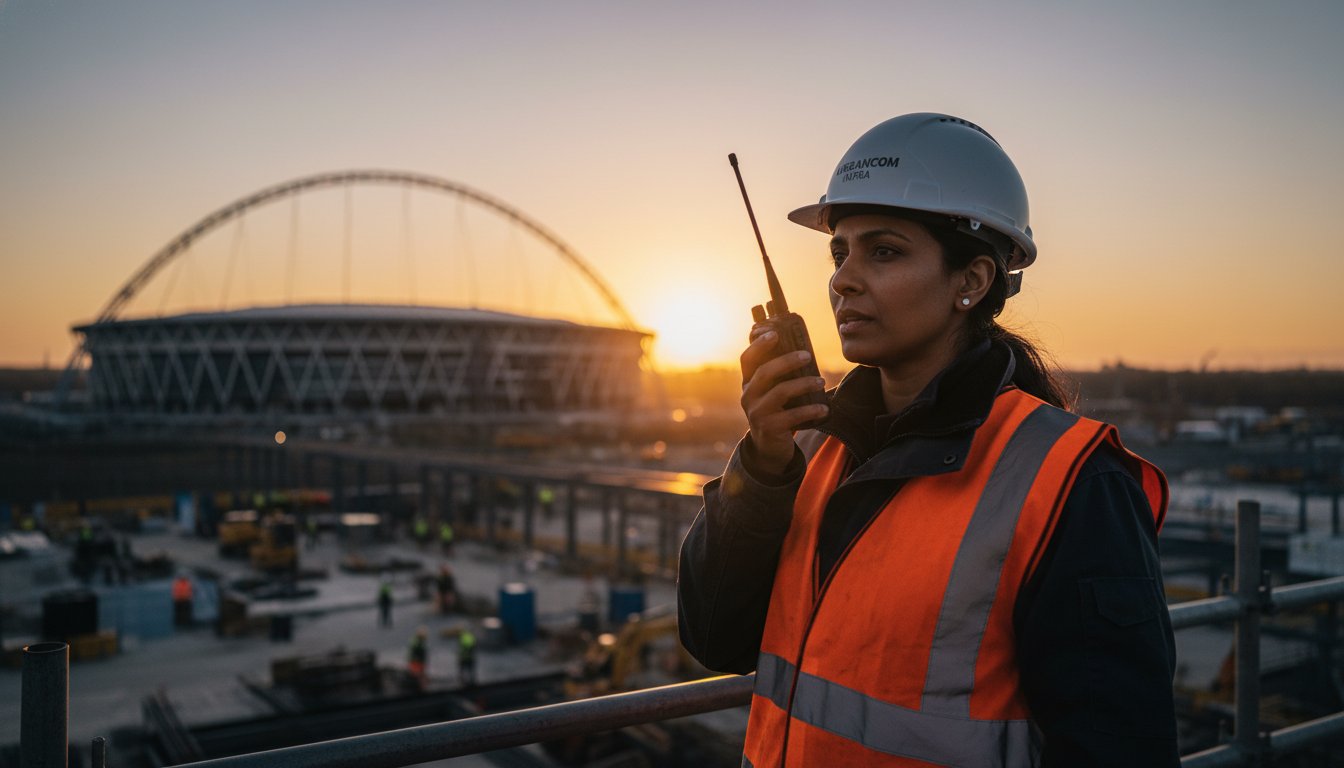
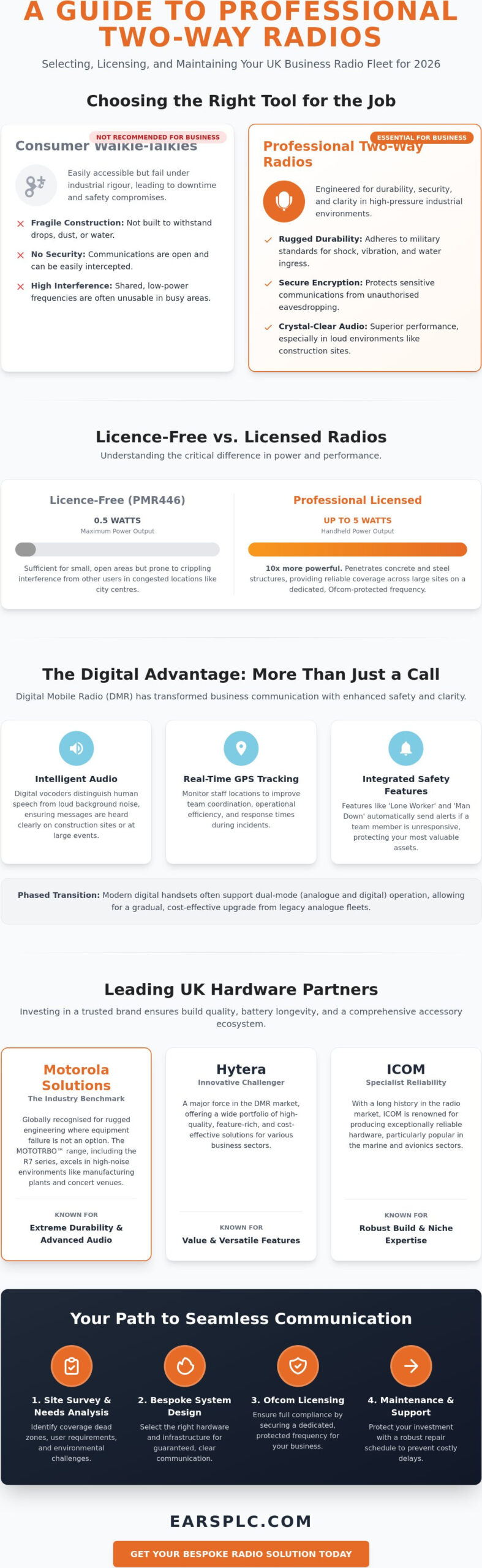
Professional communication in the UK requires more than just a basic handset; it demands a managed ecosystem that can withstand the rigours of industrial environments. When we discuss professional two way radios UK fleets, we are referring to hardware engineered for longevity and technical precision. Unlike consumer walkie-talkies found in high-street shops, professional-grade equipment adheres to military standards for shock, vibration, and water ingress. These devices are essential for high-capacity environments, such as security teams managing crowds at Wembley Stadium or logistics managers coordinating complex movements in Slough. Two-way radio technology has evolved to prioritise this level of durability, ensuring that a dropped handset doesn’t result in a total communication failure.
Reliability in a professional context is also defined by security. High-tier radios utilise encryption protocols that prevent unauthorised eavesdropping, a critical requirement for security firms and sensitive industrial operations. This focus on stability and privacy distinguishes professional hardware from entry-level alternatives. It ensures that your operational continuity remains intact, regardless of the physical or electronic environment.
Licensed vs Licence-Free: Which Does Your Business Need?
Many businesses initially consider licence-free PMR446 radios due to their lack of recurring costs. However, these units are limited to 0.5 watts of power and operate on a narrow band of shared frequencies. In congested urban centres like London or Manchester, this often results in significant interference and limited range. Professional licensed radios operate at up to 5 watts for handhelds, providing the penetration needed for concrete structures and large sites. This increased power, combined with a dedicated frequency assigned by Ofcom, ensures your security or safety team isn’t interrupted by neighbouring businesses or hobbyist users.
The Evolution of Digital Two-Way Radio Technology
The shift from analogue to Digital Mobile Radio (DMR) has transformed how UK businesses operate. Digital systems use vocoders to distinguish between human speech and background noise, which is vital on loud construction sites or in busy event venues. Beyond clear audio, digital technology introduces integrated safety features such as GPS tracking and lone worker alerts. These tools allow managers to monitor staff locations in real-time and receive immediate notifications if a team member is unresponsive. In these high-activity environments, physical boundaries are also crucial for safety; find out more about the durable fencing solutions provided by Romford Fencing Ltd. For organisations still using legacy analogue fleets, modern digital handsets often support dual-mode operation, allowing for a phased and methodical transition to more secure, encrypted communication without replacing every unit simultaneously.
Comparing Leading Brands: Motorola, Hytera, and ICOM
Selecting a hardware partner is a critical step in establishing a reliable communication network. In the UK, the market is dominated by three primary manufacturers: Motorola Solutions, Hytera, and ICOM. Each brand offers distinct advantages tailored to different logistical needs, but they all share a commitment to the durability required for professional use. When investing in professional two way radios UK organisations must look beyond the initial unit cost. Long-term value is found in build quality, battery longevity, and the availability of a comprehensive accessory ecosystem. Chargers, multi-unit docking stations, and high-quality earpieces aren’t merely optional extras; they’re essential components that ensure your fleet remains operational throughout a full shift.
Regardless of the manufacturer you choose, legal operation within the UK requires adherence to Ofcom business radio licensing. This ensures your chosen hardware operates on a protected frequency, mitigating the risk of interference from external sources. For businesses managing complex sites, choosing a brand with a proven track record in the UK ensures that replacement parts and technical support are readily available when needed.
Motorola Solutions: The Industry Benchmark
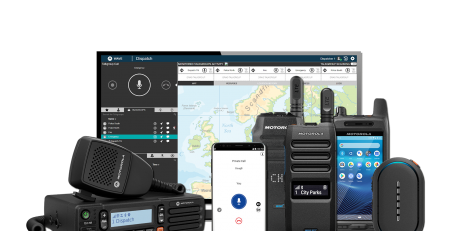
Motorola Solutions remains the global standard for industrial communication. Their Mototrbo range is engineered for environments where equipment failure isn’t an option. The Motorola R7 series has become a particular favourite for high-noise sites, such as manufacturing plants or concert venues, due to its advanced internal processing that isolates speech from heavy machinery or music. Motorola also leads the way in integrated security solutions. Many of their modern handsets are designed to work seamlessly with body-worn cameras, providing a unified data and voice stream that is invaluable for security teams in urban centres. When evaluating these options, businesses often benefit from a tailored site survey to determine which specific models best suit their building’s architecture.
Hytera and ICOM: Innovation and Specialised Performance
Hytera has established a significant presence by offering feature-rich, sleek devices that facilitate a smooth transition from analogue to digital systems. Their hardware often provides a more compact form factor without sacrificing the ruggedness required for facilities management or retail environments. ICOM, by contrast, is frequently the preferred choice for sectors requiring extreme physical resilience. With a heritage deeply rooted in marine and aviation communication, ICOM hardware is built to withstand saltwater, heavy rain, and significant physical impact. For multi-site facilities management in London, where teams may move between indoor and outdoor environments, the waterproof ratings of ICOM devices provide a necessary layer of protection against the British weather.
Navigating Ofcom Licensing and Bespoke System Design
Operating professional two way radios UK wide requires a firm understanding of the regulatory framework managed by Ofcom. It isn’t merely a matter of convenience; it’s a legal requirement that ensures your transmissions don’t interfere with emergency services or other businesses. The continued growth of the Professional Mobile Radio (PMR) market, which continues to expand globally due to its critical role in public safety and industrial efficiency, highlights the increasing reliance on these dedicated networks. In a crowded RF environment like London, the difference between a functional system and a failing one often comes down to the quality of frequency planning and initial system design.
Bespoke system design is the process of tailoring a communication network to the specific geography and architecture of your site. It moves beyond simply purchasing handsets and focuses on creating a reliable signal path. This approach is essential for maintaining operational continuity, especially in environments where structural barriers or distance would otherwise lead to communication dead zones.
Ofcom Licensing Simplified for UK Businesses
Choosing the correct licence is vital for legal compliance. A “Simple Site Light” licence is often appropriate for smaller facilities, providing a straightforward path to legal operation for a £75 fee every five years. For larger developments or high-pressure urban environments, a “Technically Assigned” licence is usually necessary. This allows for higher power outputs and specific frequencies that are protected from local interference. Using high-power professional equipment without the correct licence is a serious risk, as non-compliance can result in fines of up to £5,000. We manage the entire application and renewal process on behalf of our clients, ensuring that your fleet remains fully compliant with UK regulations at all times.
Site Surveys and System Infrastructure
Hardware alone cannot overcome the physical limitations of a site’s architecture. Steel-reinforced concrete, subterranean levels, and dense urban surroundings often create signal barriers. A professional site survey is the first step in identifying these obstacles. By conducting a technical evaluation of your premises, we can determine the optimal placement for repeaters, which extend the range of your fleet across vast geographic areas or multiple floors. For organisations with complex requirements, we design IP-linked systems that allow for seamless communication between different UK locations. This level of infrastructure ensures that your team remains connected, whether they are on the same factory floor or at a completely different site across the country.
Maximising Operational Continuity: Maintenance and Repairs
Operational stability depends on more than just the initial procurement of hardware. When professional two way radios UK fleets are neglected, the resulting communication downtime can lead to significant logistical bottlenecks and safety compromises. The hidden costs of equipment failure aren’t limited to the price of a replacement handset; they include lost productivity, delayed response times, and potential breaches in security protocols. To mitigate these risks, a structured preventative maintenance schedule is essential. Regular testing of battery health, signal clarity, and physical integrity ensures that your communication remains a dependable asset rather than a liability.
Maintaining a fleet involves technical oversight that goes beyond simple cleaning. Professional radio programming, for example, allows for the creation of dedicated talk groups and emergency override features. These configurations are vital for security teams who need to isolate specific conversations or broadcast urgent alerts across the entire network. Without expert programming, even the most advanced hardware remains under-utilised and potentially insecure.
Expert Repair and Programming Services
Antenna damage, battery degradation, and software bugs are the most frequent causes of radio failure in industrial settings. Using an authorised UK repair centre is critical for maintaining warranty protection and ensuring that repairs meet the original manufacturer’s specifications. Expert technicians can recalibrate devices to ensure they operate at peak efficiency, whilst custom programming can be updated to reflect changes in your operational requirements. If you require immediate assistance with your fleet, explore our professional radio repair and maintenance services.
Hire vs Purchase: A Strategic Financial Decision
The choice between direct purchase and radio hire is often a matter of financial strategy and operational duration. For short-term events in areas like Wembley or Richmond, hiring provides access to the latest Motorola or Hytera technology without the long-term commitment of ownership. This approach is typically treated as an operational expenditure (OPEX), which can offer distinct tax advantages for certain businesses. It also ensures that equipment is always up to date and fully serviced before it arrives on site.
Conversely, purchasing equipment is a capital expenditure (CAPEX) that may be more cost-effective for organisations with permanent, multi-year requirements. However, long-term rental agreements often include comprehensive technical support and maintenance as part of the package, providing a level of logistical stability that direct ownership might lack. We help our clients navigate these financial options to find the most sustainable approach for their specific budget and timeline, ensuring that communication remains a constant, reliable presence in their operations.
Why Ears PLC is the Trusted Partner for UK Radio Solutions
Effective communication is the backbone of any successful operation, yet it requires a partner who understands the specific geographical and technical challenges of the British landscape. With over two decades of experience in the UK communication sector, Ears PLC has established itself as a dependable authority for organisations requiring professional two way radios UK wide. Our expertise isn’t limited to hardware sales; we provide a comprehensive service that encompasses site surveys, frequency planning, and dedicated project management. This end-to-end approach ensures that your communication system is designed with your specific operational environment in mind, whether you’re managing a high-profile event in Wembley or a complex logistics hub in Harrow.
As an authorised supplier and repair centre for market leaders such as Motorola, Hytera, and ICOM, we maintain the technical competence required to support high-pressure environments. Our local expertise across London and the surrounding boroughs allows us to provide on-site support that is both efficient and informed by local signal conditions. We prioritise long-term relationships over fleeting trends, focusing on solutions that offer longevity and logistical precision for every client we serve.
A Steady Hand for Complex Communication Needs
We operate as a stabilising partner for our clients, often anticipating potential issues before they can disrupt your operations. Our commitment to technical precision is evident in how we support large-scale logistics and events. For instance, managing communication for major venues requires a deep understanding of crowd dynamics and structural interference. By integrating our hardware with tailored systems design, we ensure that security and management teams remain connected regardless of the environment’s complexity. This proactive approach to communication management allows your staff to focus on their core responsibilities without the distraction of equipment failure or signal loss.
Getting Started with Your Professional Radio Fleet
Establishing a reliable radio network begins with a thorough understanding of your current infrastructure. We recommend requesting a technical site survey to evaluate your existing coverage and identify any potential dead zones that could compromise safety or efficiency. Following this evaluation, we develop a tailored solution that fits your industry’s unique demands, whether that involves short-term hire for a seasonal peak or a full system installation for a permanent facility. Our team handles every aspect of the process, including the management of Ofcom licensing and bespoke frequency programming. To ensure your team has the tools they need for seamless connectivity, speak with an Ears PLC expert about your radio requirements today.
Securing Operational Stability for Your Business Communication
Establishing a resilient communication network requires a transition from basic hardware to a fully managed ecosystem. By selecting high-tier equipment from manufacturers like Motorola, Hytera, or ICOM, you ensure your team remains connected in environments where consumer devices simply fail. Integrating these tools with professional system design and adherence to Ofcom regulations mitigates the risk of interference and legal non-compliance, protecting your long-term investment. Whether you choose a permanent purchase or a flexible hire arrangement, the focus remains on maintaining operational continuity without the disruption of equipment downtime.
Ears PLC has provided this level of technical precision since 1999. As an authorised partner for the industry’s leading brands, we offer more than just hardware; we provide on-site support and dedicated project management to ensure your professional two way radios UK fleet performs at its peak. Our decades of experience allow us to anticipate your logistical needs, providing a steady hand for your most complex communication challenges. Contact Ears PLC for professional radio sales, hire, and expert advice to begin optimising your site’s connectivity. We look forward to helping you establish a reliable foundation for your business operations.
Frequently Asked Questions
Do I need a licence for professional two-way radios in the UK?
Yes, a licence is mandatory for operating professional-grade equipment to ensure you don’t interfere with other users. Most businesses opt for an Ofcom Simple UK Light licence, which allows for portable use across the country. For fixed sites with specific coverage requirements, a Technically Assigned licence is necessary to protect your dedicated frequency from local congestion.
What is the range of a professional two-way radio on a London site?
The effective range of professional two way radios UK fleets depends heavily on the surrounding architecture and topography. In a dense urban environment like London, handheld-to-handheld range may be limited to one or two kilometres due to physical obstructions. However, by integrating a repeater system during the systems design phase, you can extend this coverage significantly across several floors or vast geographic areas.
Can I mix different brands of radios like Motorola and Hytera?
You can use different brands within the same fleet provided they operate on the same frequency and use the same digital standard, such as DMR. Whilst the core voice functions will typically work across brands after professional programming, some proprietary features like advanced encryption or specific emergency protocols might not be fully compatible. We recommend a technical evaluation to ensure seamless integration between different manufacturers.
What happens if my radios stop working during a major event?
We provide on-site support and dedicated project management to resolve technical issues immediately during high-pressure operations. Having a preventative maintenance schedule in place reduces the risk of failure, but for critical events, we can provide standby engineers and spare hardware. This level of logistical support ensures that a single equipment fault doesn’t compromise the safety of your entire site.
How much does an Ofcom radio licence cost for a UK business?
An Ofcom Simple UK Light or Simple Site Light licence currently costs £75 for a five-year period. These are cost-effective options for many organisations requiring straightforward communication. If your operation requires a Technically Assigned licence for a specific site, the fee starts at £75 but can increase depending on the number of channels and the level of frequency congestion in your area.
Should I buy or hire two-way radios for a 3-month construction project?
Hiring is generally the most efficient choice for a three-month project because it eliminates the initial capital expenditure and includes technical support. Radio hire allows you to treat the cost as an operational expense whilst ensuring you have access to the latest, fully serviced equipment. It also removes the long-term responsibility of maintenance and licence management once the project concludes.
What is the difference between analogue and digital (DMR) radios?
Digital radios provide superior audio clarity by using software to filter out background noise, which is essential in loud industrial environments. Unlike analogue systems, digital technology maintains clear voice quality right to the edge of the coverage area and offers better battery efficiency. Digital handsets also support advanced safety features such as GPS tracking, text messaging, and lone worker alerts.
Do professional radios work inside basements or reinforced concrete buildings?
Signal penetration in subterranean or heavily reinforced structures is often limited without additional infrastructure. Standard radio waves struggle to pass through thick concrete and steel, leading to communication dead zones. To solve this, we conduct site surveys to identify weak spots and install repeaters or bespoke antenna systems that ensure reliable connectivity in even the most challenging architectural environments.