+44 7966 145 771
Ears_Professional-Two-Way-Radio-Maintenance-UK-The-Essential-Guide-for-Business-Continuity.html
Professional Two-Way Radio Maintenance UK: The Essential Guide for Business Continuity
Communication downtime during a critical service isn’t merely a technical glitch; it’s a direct threat to operational continuity. Professional two way radio maintenance UK services transform your communication fleet from a potential point of failure into a dependable asset. You likely understand the frustration of a handset failing mid-shift or the sting of unexpected repair costs when a two-way radio unit goes down. It’s a common pain point for many site managers, security personnel who rely on instant connectivity to keep their teams safe and efficient.
This guide shows you how proactive care ensures your fleet remains reliable, and cost-effective throughout its entire lifecycle. We’ll examine the specific strategies used to achieve zero downtime for security and logistics teams whilst maintaining a predictable maintenance budget. From understanding the technical requirements of flagship models like the MOTOTRBO R7 to managing your Ofcom licensing obligations, you’ll discover how to protect your investment and ensure seamless communication across your entire site.
Key Takeaways
- Identify the “silent costs” of communication failure and how professional two way radio maintenance UK serves as a strategic safeguard for operational stability.
- Learn the difference between basic repairs and comprehensive technical inspections that cover casing integrity, antenna seals, and battery capacity testing.
- Discover how to move beyond the reactive “break-fix” cycle by utilising Service Level Agreements designed to ensure zero downtime for critical teams.
- Establish a first line of defence with practical daily care routines and charging etiquette that extend the lifespan of your Motorola or Hytera equipment.
- Gain insights into how 25 years of industry experience and manufacturer-trained engineering support can streamline your fleet management and budgeting.
Table of Contents
- What is Two-Way Radio Maintenance and Why is it Critical?
- The Core Components of a Professional Maintenance Programme
- Preventative Maintenance vs. Reactive Repairs: Choosing Your Strategy
- Daily and Weekly Radio Care: A Checklist for Your Team
- The Ears PLC Approach: Expert Two-Way Radio Maintenance in London and the UK
What is Two-Way Radio Maintenance and Why is it Critical?
Professional two way radio maintenance UK is far more than a cursory wipe-down of a handset. It’s a structured regimen that combines detailed technical inspections, software optimisations, and physical repairs to ensure operational continuity. Understanding what is a two-way radio and the complexities of its internal circuitry is essential for any business leader. These devices are precision instruments that require regular calibration to function within the strict parameters of their design. Implementing a rigorous schedule for two way radio maintenance UK ensures that these safety-critical systems never fail during a crisis.
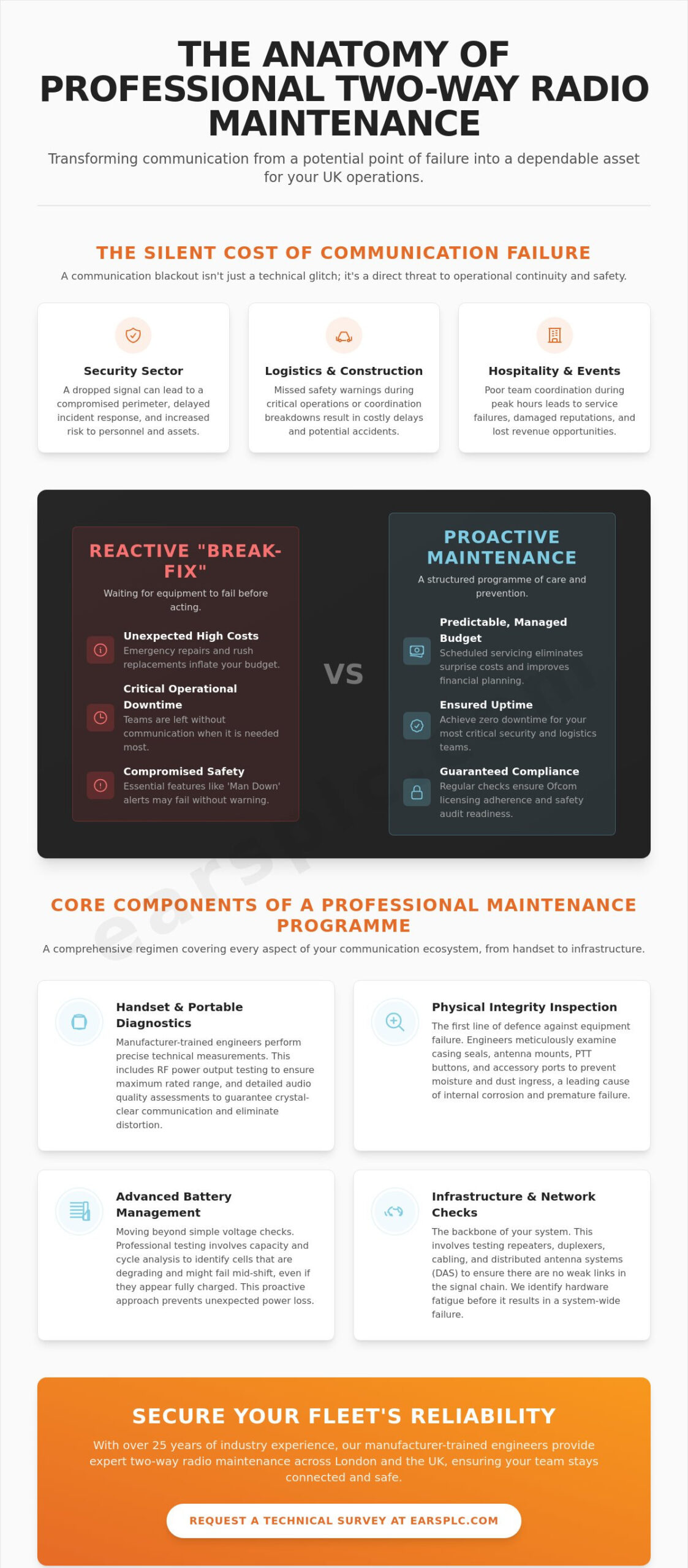
Communication failure carries a significant silent cost that often goes unnoticed until a breakdown occurs. In the security sector, a dropped signal or a dead battery can lead to a compromised perimeter. In construction, it might result in a missed safety warning during a heavy lift. Hospitality managers frequently face lost revenue and damaged reputations when coordination breaks down during peak hours. These aren’t just minor inconveniences; they’re tangible operational risks that directly impact your bottom line and staff safety.
There’s a fundamental difference between basic cleaning and professional diagnostic testing. Whilst your team can manage daily surface care, only manufacturer-trained engineers possess the tools to perform frequency alignment and sensitivity testing. This technical oversight ensures your fleet meets strict Ofcom licensing requirements. Without this level of precision, handsets can drift off-frequency, causing interference with other local users and potentially leading to regulatory investigations or fines.
The Lifecycle Benefits of Regular Servicing
Premium hardware from Motorola, Hytera, or ICOM represents a significant capital investment for any organisation. Regular servicing extends the operational life of these units, which significantly reduces the Total Cost of Ownership (TCO). By preventing the need for premature replacements through proactive care, you keep your maintenance budget predictable and manageable. It also ensures that if you eventually choose to upgrade, your existing fleet retains a much higher resale or trade-in value due to its documented service history.
Safety and Compliance in the UK Market
Safety features such as ‘Man Down’ and ‘Lone Worker’ alerts are only effective if they are fully functional and correctly programmed. Routine maintenance verifies these emergency triggers work exactly as intended, providing a vital safety net for your team. Furthermore, precise frequency alignment is necessary to prevent interference with other businesses across London and the wider UK. This technical discipline ensures your organisation remains compliant during health and safety audits, demonstrating a clear commitment to duty of care and regulatory standards. For businesses looking to audit their current fleet, our team provides tailored on-site support and technical surveys.
The Core Components of a Professional Maintenance Programme
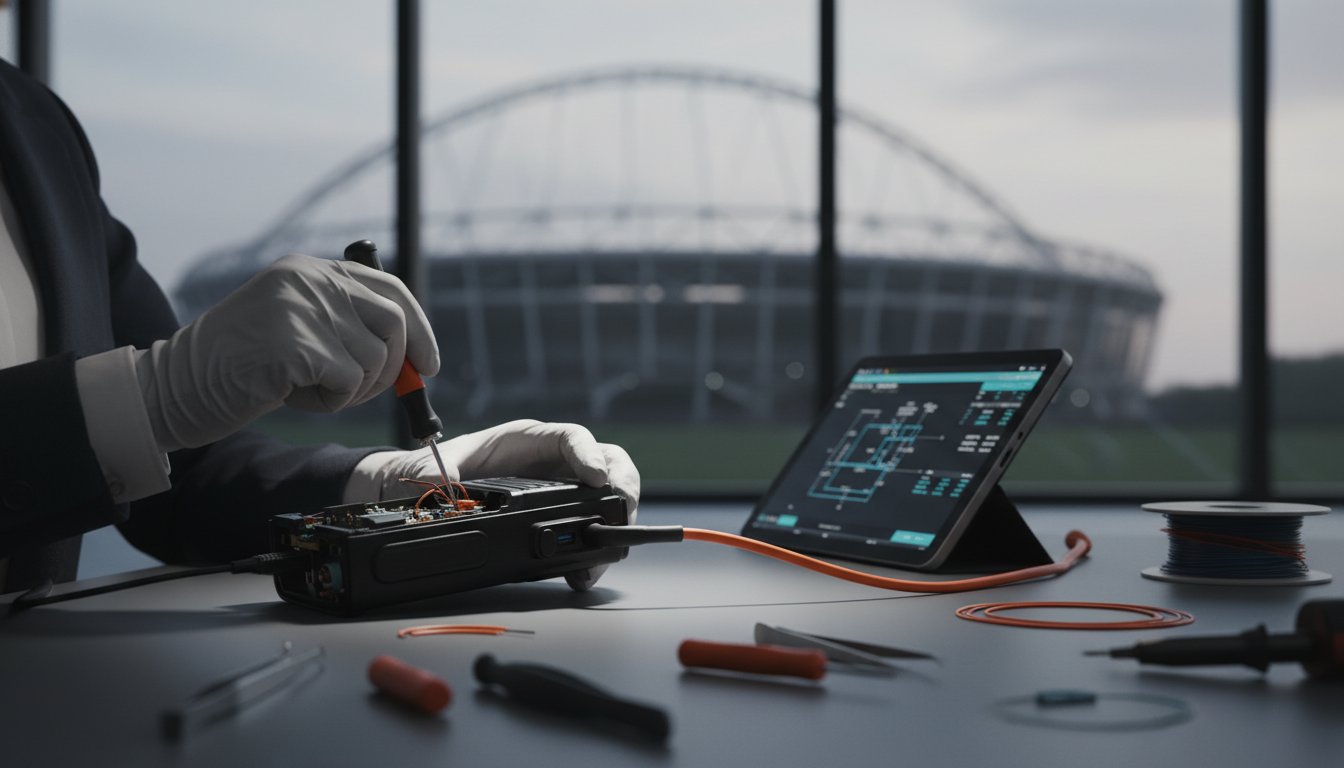
A comprehensive programme for two way radio maintenance UK must address the entire communication ecosystem, from the individual handset to the backbone infrastructure. Physical integrity is the first priority. Engineers examine casing seals, antenna mounts, and accessory ports to prevent moisture ingress, which is a leading cause of internal corrosion. Battery management also moves beyond simple voltage checks. Professional testing involves capacity and cycle analysis to identify cells that might fail mid-shift, even if they appear fully charged on a standard dock.
Infrastructure checks are equally vital for maintaining a stable network. This involves testing repeaters, cabling, and distributed antenna systems (DAS) to ensure there are no weak links in the signal chain. By identifying hardware fatigue before it results in a system-wide failure, you maintain the logistical stability your operations require. This methodical approach ensures that every component, no matter how small, is performing to its manufacturer’s specifications.
Handset and Portable Radio Diagnostics
Maintaining peak performance requires precise technical measurements. Our engineers perform RF power output testing to ensure your handsets achieve their maximum rated range. We also conduct detailed audio quality assessments, which include cleaning internal microphones and testing speaker clarity to eliminate distortion. Frequency alignment is equally vital. Over time, electronic components can ‘drift’, leading to degraded signal quality. Regular calibration keeps your fleet locked to its assigned channels, ensuring clear communication across your site.
System Infrastructure and Fixed Equipment
Reliability often depends on the equipment your team never sees. In high-pressure environments like Wembley Stadium or industrial hubs in Slough, the infrastructure must be robust. Maintenance includes inspecting base stations, repeaters, and distributed antenna systems. We check the Standing Wave Ratio (SWR) of antennas to prevent reflected power from damaging expensive transmitters. Testing backup power supplies and Uninterruptible Power Supplies (UPS) is also a standard procedure to guarantee that your critical operations remain online during a power failure.
Software and Licensing Management
Modern digital radios are essentially sophisticated computers. Keeping firmware updated is necessary to patch security vulnerabilities and access new manufacturer features. We also manage the administrative side of your fleet. This involves reviewing your Ofcom licence data to ensure all frequencies and power levels remain legally compliant. If your operational requirements have changed, our team can assist with professional frequency planning services to optimise your coverage. Ensuring your documentation matches your hardware is a key part of a disciplined maintenance strategy. For a thorough evaluation of your current system’s health, you may wish to speak with one of our technical project managers.
Ears Plc_Professional Two-Way Radio Maintenance UK
Preventative Maintenance vs. Reactive Repairs: Choosing Your Strategy
Choosing between preventative and reactive strategies is a fundamental decision for any fleet manager. The common “Break-Fix” model often appears cost-effective on paper because it avoids upfront fees. However, this approach ignores the hidden costs of operational disruption. When a radio fails during a high-stakes event, the immediate loss of coordination can lead to security breaches or logistical bottlenecks. Relying solely on reactive repairs typically results in higher long-term expenses due to emergency shipping, expedited labour, and the eventual need for wholesale equipment replacement.
Professional two way radio maintenance UK provides a structured alternative that prioritises stability. By scheduling regular technical interventions, you identify wear and tear before it translates into a total system failure. This proactive stance is particularly critical in harsh environments. A dusty construction site in East London places far more strain on antenna seals and speaker grilles than a climate-controlled retail centre in the West End. Tailoring your maintenance schedule to these specific environmental demands ensures your equipment remains resilient against the elements.
Predictable budgeting is another significant advantage of a maintenance-led approach. Contracts allow you to move from erratic, emergency spending to a fixed operational cost. This eliminates the “nasty surprises” that can derail a quarterly budget when multiple handsets or a central repeater require urgent attention. It’s about moving from a position of uncertainty to one of quiet authority over your assets.
When Ad-Hoc Repairs Make Sense
Reactive repairs do have a specific, limited place in a broader management strategy. If you operate a small fleet of licence-free PMR446 radios for low-risk tasks, ad-hoc servicing may be sufficient for your needs. This model is also appropriate for handling accidental physical damage, such as a handset being dropped from a height or submerged beyond its IP rating, which falls outside the scope of routine wear. For non-critical backup units, a professional mail-in service provides a sensible way to manage repairs without the need for a dedicated on-site engineer.
The Power of the Maintenance Contract (SLA)
For organisations where communication is non-negotiable, a Service Level Agreement (SLA) is the gold standard. These contracts provide guaranteed response times for on-site support in areas like Richmond or Kingston, ensuring that technical help is always available when needed. A dedicated contract includes regular preventative visits where engineers perform deep diagnostics to catch minor issues before they escalate into outages. Priority access to loan equipment also ensures your team stays connected even during complex repair periods. This level of support provides a steady hand for your operations, allowing you to focus on your core business whilst we manage the technical integrity of your fleet. If you’re looking to stabilise your communication costs, you can enquire about our tailored maintenance packages.
Daily and Weekly Radio Care: A Checklist for Your Team
Establishing a culture of equipment care is the most effective way to support your professional two way radio maintenance UK strategy. Whilst technical engineers handle the complex internal calibrations, your team serves as the first line of defence against hardware failure. Simple daily habits significantly reduce the likelihood of a handset failing during a shift. This disciplined approach ensures that your Motorola or Hytera units remain in peak condition, preventing minor wear from escalating into expensive technical faults.
Proper charging etiquette is a critical part of this routine. Modern Lithium-Ion batteries don’t suffer from the ‘memory effect’ of older technologies, but they are sensitive to heat and charging cycles. Ensure your team only places radios in chargers when the battery is low, rather than ‘topping up’ throughout the day. This simple change in behaviour can add months to the operational life of a battery pack, keeping your maintenance budget focused on performance rather than constant replacements.
Daily User Checks Before Every Shift
Before any team member heads out on site, they should perform a quick three-point inspection. First, examine the antenna for any signs of bending or cracking at the base. It’s a common but damaging habit to carry a radio by its antenna; this puts immense strain on the internal RF connector. Second, check the battery contacts for any signs of oxidation or debris. A quick wipe with a dry, lint-free cloth ensures a stable power connection. Finally, always perform a ‘radio check’ with a colleague to confirm that both transmit and receive audio are crisp and clear.
Weekly Supervisor Inspections
Once a week, a supervisor should conduct a more thorough audit of the fleet. This is particularly important for teams operating in high-activity areas like Borehamwood, Sunbury, or Wimbledon where equipment is used intensively. Look for missing belt clips or loose accessory port covers, as these protect the radio’s IP rating against moisture and dust. We also recommend rotating batteries across the handset pool to ensure even usage. During this time, identify any ‘problem’ handsets that staff report as underperforming. Catching these units early allows for a targeted technical review before they fail completely.
Cleaning and Environmental Care
Keeping your equipment clean is about more than aesthetics; it’s about maintaining the integrity of the electronics. Use a damp cloth with mild soapy water to clean the outer casing, but never submerge the unit unless you’re certain its IP rating allows it. Avoid using compressed air on microphone or speaker ports. The high pressure can easily rupture the delicate internal membranes, leading to distorted audio. Finally, always ensure that handsets are completely dry before they are placed back into rapid chargers to prevent short-circuiting. If your team has identified units that require professional attention, contact our technical team for an expert repair assessment.
The Ears PLC Approach: Expert Two-Way Radio Maintenance in London and the UK
For over 25 years, Ears PLC has served as a steady hand for organisations requiring absolute communication reliability. We’ve navigated decades of industry shifts, from the early days of analogue to the sophisticated digital systems used today. This experience allows us to provide a level of two way radio maintenance UK businesses can depend on, regardless of their operational scale. We don’t just fix hardware; we manage your entire communication ecosystem with a focus on logistical stability and technical precision. Our engineers are manufacturer-trained for Motorola, Hytera, and ICOM systems, ensuring that every repair or calibration meets the exact specifications of the original equipment.
Local expertise is the cornerstone of our service delivery. Whilst some providers offer a distant, impersonal service, we maintain a strong presence across London, Wembley, Harrow, and the surrounding home counties. This proximity allows us to understand the unique geographical and technical challenges of the region, from the high-interference environments of the city centre to the expansive requirements of industrial parks. We provide bespoke maintenance packages that are specifically tailored to your industry’s pressure points, ensuring your budget is always utilised effectively.
On-Site Support and Project Management
Effective maintenance requires more than just technical skill; it demands organised project management. Our dedicated project managers act as a bridge between your operational team and our technical department, anticipating your needs before they become critical problems. We provide rapid on-site response for essential infrastructure in London and Slough, minimising the risk of prolonged outages. Our engineers also conduct comprehensive site surveys to evaluate your current system health and optimise coverage. This thorough approach ensures that your distributed antenna systems and repeaters are always performing at their peak capacity.
Why Partner with Ears PLC?
Choosing a maintenance partner is a strategic decision that impacts your long-term operational continuity. We prioritise enduring relationships over fleeting transactional sales, positioning ourselves as a stabilising partner for your business. Our team possesses a deep understanding of diverse professional sectors, from facilities management and retail to large-scale event security. This industry-specific knowledge allows us to tailor our technical approach to the specific pitfalls of your environment. We remain committed to technical excellence and logistical precision in every repair, ensuring your fleet remains a reliable asset for years to come. If you’re ready to secure your communication infrastructure, contact our expert team to discuss your maintenance requirements.
Securing Your Communication Future through Technical Excellence
Maintaining a reliable communication fleet is a continuous process that requires both technical discipline and expert oversight. By shifting from a reactive “break-fix” mindset to a proactive strategy, you protect your organisation from the silent costs of equipment failure and operational downtime. Implementing a structured regimen for two way radio maintenance UK ensures that your handsets, repeaters, and infrastructure remain fully compliant with Ofcom regulations whilst performing at their peak capacity. These small, consistent investments in care significantly extend the operational life of your premium Motorola, Hytera, or ICOM assets.
Ears PLC has provided this steady hand to UK businesses since 1999. As an authorised partner for leading manufacturers, we bring decades of technical expertise and logistical precision to every project. With local support hubs situated across London and the South East, our engineers are positioned to respond rapidly to your needs. We invite you to Book a Professional Maintenance Review with Ears PLC to evaluate your current system health and establish a predictable, cost-effective maintenance plan. Your team’s safety and connectivity are too important to leave to chance.
Frequently Asked Questions
How often should my two-way radios be professionally serviced?
Professional servicing is generally recommended at least once every twelve months to ensure signal integrity and hardware durability. For high-intensity environments such as construction sites or large-scale security operations, bi-annual inspections are often necessary to manage accelerated wear on casing seals and battery health. Regular technical reviews prevent minor issues from escalating into system-wide failures.
Can I repair my own Motorola or Hytera radio if it stops working?
Self-repair is strongly discouraged for professional-grade digital handsets. These devices are precision instruments that require specialised diagnostic tools for frequency alignment and IP-rating verification. Attempting an unauthorised repair typically voids manufacturer warranties and can compromise the device’s signal integrity or its ability to withstand moisture and dust ingress.
What is the typical turnaround time for a radio repair service in the UK?
Standard turnaround times for professional two way radio maintenance UK typically range from three to five working days. This period allows for a full diagnostic sweep, the installation of genuine manufacturer parts, and final quality control testing. Organisations with a Service Level Agreement often receive priority scheduling or access to loan equipment to ensure their operations remain uninterrupted.
Is it cheaper to repair an old radio or replace it with a new model?
The choice depends on the age of the hardware and the specific nature of the fault. If a repair cost approaches 50% of the price of a new handset, or if the model is no longer receiving firmware updates, replacement is usually the more stable long-term investment. Maintaining a fleet with modern, supported hardware reduces the total cost of ownership over time.
What are the signs that my radio battery needs to be replaced?
The most obvious sign is a significant reduction in shift life, where the battery fails to last a standard eight-hour period. You should also look for physical indicators such as swelling of the battery casing or oxidation on the metal contacts. Professional capacity testing can accurately determine if a battery has dropped below its effective operational threshold.
Do you provide maintenance for radios not originally purchased from Ears PLC?
Yes, we provide technical support for radio fleets regardless of where they were originally acquired. Our engineers are trained to maintain and repair all major professional brands, including Motorola, Hytera, and ICOM. We can perform a full site survey and technical audit to integrate your existing equipment into a structured maintenance programme.
What happens if my radio system fails outside of normal business hours?
Organisations that require constant connectivity should verify the specific response times outlined in their support agreement. Whilst we operate during standard business hours, our maintenance strategies are designed to prevent failures through proactive technical care. We recommend discussing tailored on-site support options for critical infrastructure that must remain operational 24/7.
How does professional programming differ from basic channel selection?
Professional programming involves the configuration of complex logic such as digital encryption, talk-group hierarchies, and emergency safety triggers. It ensures that every handset operates strictly within the parameters of your Ofcom licence to prevent interference. This technical process is essential for coordinating large teams and maintaining secure, organised communication across a professional site.