+44 7966 145 771
How to Implement a Professional Two-Way Radio System for UK Schools
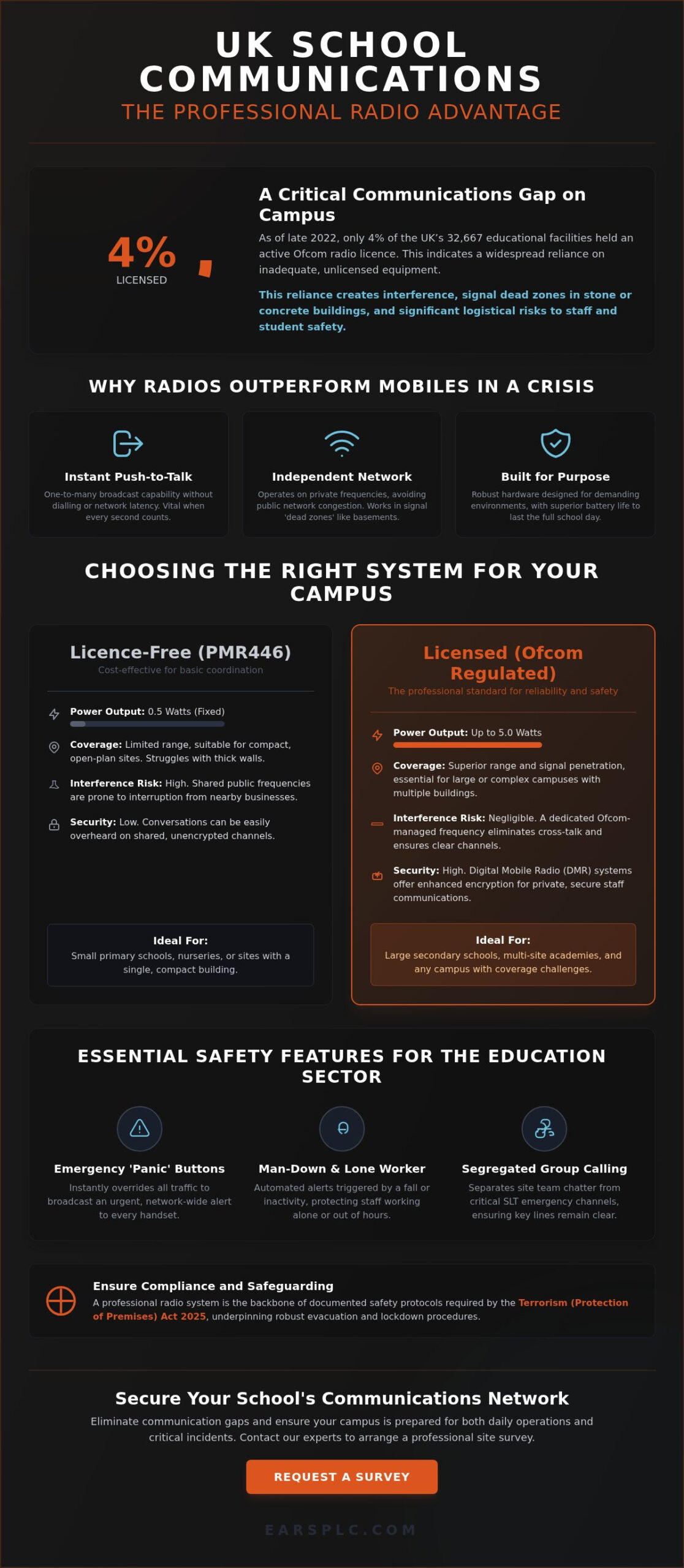
Did you know that as of late 2022, only 4% of the UK’s 32,667 educational facilities held an active Ofcom radio licence? This statistic suggests that a vast majority of sites rely on unlicensed equipment that often fails to meet the rigorous demands of a modern campus. If you’ve experienced interference from neighbouring businesses or signal dead zones in older stone buildings, you know that unreliable communication is more than a nuisance; it’s a logistical risk. Implementing a professional two way radio for schools UK system is essential for maintaining operational continuity and staff safety.
We understand that school managers prioritise dependable solutions that work the first time, every time. This guide offers a clear, technical roadmap for selecting, licensing, and maintaining a robust radio network tailored to the unique layout of your site. You’ll learn how to eliminate communication gaps, ensure compliance with the Terrorism (Protection of Premises) Act 2025, and build a durable fleet that remains functional for years. We’ll examine the transition from fragmented hardware to a seamless, professional communication infrastructure that supports both daily operations and critical safeguarding incidents.
Key Takeaways
- Learn why a dedicated radio network is superior to mobile devices for emergency broadcasts and instant campus-wide coordination.
- Compare the technical benefits of licensed systems against PMR446 options to choose the most reliable two way radio for schools UK based on your site’s specific requirements.
- Identify and resolve signal dead zones in complex school buildings through professional site surveys and strategic equipment placement.
- Maximise the longevity of your hardware and avoid common equipment failures by implementing a preventative maintenance schedule and professional repair path.
Table of Contents
- Understanding the Role of Two-Way Radios in UK School Safety
- Choosing Between Licensed and Licence-Free Radios for Your Campus
- A Step-by-Step Guide to Implementing Your School Radio System
- Managing and Maintaining Your School Radio Fleet for Longevity
Understanding the Role of Two-Way Radios in UK School Safety
A professional two way radio for schools UK is more than a simple communication tool; it’s a dedicated safety network designed for high-pressure environments. Unlike public cellular networks, these systems operate on private frequencies, ensuring your staff aren’t competing for bandwidth during a crisis. Understanding two-way radio technology helps in recognising that these devices provide an instantaneous “one-to-many” broadcast capability. This is vital when every second counts. With the statutory requirements of the Terrorism (Protection of Premises) Act 2025 now in effect, schools must maintain documented procedures for evacuation and lockdown. A reliable radio system serves as the backbone of these safety protocols.
Mobile phones often fail in complex school environments. They suffer from network latency and require time to unlock, dial, and connect. In a safeguarding incident, you can’t afford to wait for a call to go through. Radios offer immediate push-to-talk functionality. This ensures that site teams, first aiders, and the Senior Leadership Team (SLT) stay synchronised during fire evacuation drills or playground incidents. PE departments also rely on this stability when managing large groups across sprawling fields where mobile signals are often weak. These devices don’t rely on external masts, making them the only dependable choice for internal “dead zones” such as basements or reinforced concrete corridors.
Critical Safety Features for the Education Sector
Modern handsets come equipped with specific safety protocols designed for the unique layout of a campus. These features provide layers of protection that consumer-grade hardware simply cannot match:
- Emergency “Panic” Buttons: These allow a user to override all other traffic to broadcast an urgent alert to every handset on the network instantly.
- Man-Down and Lone Worker Alarms: For site managers working out of hours or in isolated areas, these features trigger an automated alert if the radio detects a fall or a period of inactivity.
- Group Calling: This allows you to separate administrative chatter amongst the site team from the emergency channels used by the SLT, keeping critical lines clear.
Implementing a robust two way radio for schools UK ensures that communication remains fluid even when external networks are congested or unavailable. It provides a level of logistical stability that is essential for modern campus management.
Choosing Between Licensed and Licence-Free Radios for Your Campus
Selecting the right hardware begins with understanding the regulatory environment. For small primary schools with a compact footprint, PMR446 licence-free radios offer a cost-effective entry point. These devices operate on a shared set of frequencies and are restricted to 0.5 watts of power. Whilst suitable for basic coordination, they are often prone to interference in urban areas where neighbouring businesses or retail centres use the same channels. This can lead to security concerns if external chatter interrupts staff communications.
For larger campuses or secondary schools, a licensed system is the standard for operational stability. Licensed radios operate at higher power levels, typically up to 5 watts, which significantly improves signal penetration through dense building materials. Adhering to Ofcom licensing requirements ensures your school has a dedicated frequency, reducing the risk of cross-talk from outside sources. Most modern institutions now favour Digital Mobile Radio (DMR) technology over older analogue systems. Digital units provide superior audio clarity by filtering out background noise and offer better battery life, ensuring handsets last through a full school day and after-school clubs.
When to Upgrade to a Licensed System
Transitioning to a licensed two way radio for schools UK system becomes necessary when your existing equipment no longer provides reliable coverage. If your site team reports “stepping on” other conversations or experiences signal dropouts in newer blocks built with reinforced concrete and steel, your system has likely reached its technical limit. Large secondary schools and multi-site academies require bespoke frequency allocation to manage multiple talk groups simultaneously without congestion. This level of logistical precision is only possible through a managed, licensed frequency.
A professional partner simplifies this transition by handling frequency planning and Ofcom applications on your behalf, typically securing licences for a five-year term. If you’re unsure which category fits your campus, you can contact our technical team to discuss a tailored solution for your site. This ensures your communication network remains a stabilising force during daily operations and emergencies alike.
How to Implement a Professional Two-Way Radio System for UK Schools
A Step-by-Step Guide to Implementing Your School Radio System
Successful implementation moves beyond simply purchasing hardware. It requires a structured plan to ensure the network remains reliable during peak operational times. The process begins with a professional site survey. This technical assessment identifies “dead zones” in reinforced basements, central stairwells, or remote playing fields where signal attenuation is likely. By mapping these areas early, you can determine if your campus requires additional infrastructure, such as repeaters, to maintain total coverage across the entire estate.
Determining the correct quantity of handsets should be based on specific staff roles rather than arbitrary budget figures. Effective safeguarding relies on ensuring that all first aiders, site teams, and members of the Senior Leadership Team (SLT) are equipped. Once the fleet size is established, custom radio programming is essential. This allows you to organise channels that match your school’s unique structure, separating general administrative traffic from emergency talk groups. To maintain the longevity of the equipment, establish a central charging station and a strict sign-out procedure. This ensures every two way radio for schools UK remains accounted for and fully charged at the start of each morning.
The Importance of a Site Survey
Technical site surveys are particularly critical for schools in high-density urban areas like London. These environments often face significant signal congestion and physical obstructions from neighbouring tall buildings. A survey allows engineers to calculate the exact placement of repeaters, which act as signal boosters for multi-storey blocks or expansive acreages. Integrating radios for school security effectively means ensuring no corner of the site is left in silence. You can book a professional site survey with Ears PLC to confirm your network’s integrity before deployment.
Managing and Maintaining Your School Radio Fleet for Longevity
A professional two way radio for schools UK system is a significant investment that requires a proactive approach to maintenance. Many institutions fall into the trap of the “broken radio drawer,” where handsets with minor faults are discarded rather than restored. To avoid this, schools should implement a preventative maintenance schedule. Annual inspections are essential for checking battery health and antenna integrity, as these components endure the most wear during daily campus operations. A well-maintained fleet ensures that staff aren’t left with failing equipment during a critical safeguarding incident.
Standardising your accessories also plays a vital role in operational efficiency. Earpieces are particularly important for discreet communication in corridors, allowing staff to receive sensitive information without alerting students or visitors. Beyond voice communication, the integration of body cameras has become a logical extension of school security. These devices provide objective documentation of incidents, working alongside your radio network to create a comprehensive safety framework. This layered approach to technology ensures that your team is equipped to handle both routine logistics and high-pressure situations with calm efficiency.
Repair vs Replacement: Making the Economical Choice
Deciding whether to repair or replace a handset is often a matter of technical assessment. Many common issues, such as snapped antennas, faulty PTT buttons, or degraded batteries, are easily repairable. Professional programming can also breathe new life into an older fleet by reconfiguring talk groups or updating software to improve performance. This approach is often more cost-effective than a full fleet replacement and extends the operational life of your hardware.
For institutions seeking a steady hand in fleet management, Ears PLC is the dependable partner for repairs and maintenance for schools in Harrow, Wembley, and across London. We provide specialised support for Motorola, Hytera, and ICOM units, ensuring your equipment remains a reliable asset. By prioritising professional repairs, you maintain logistical stability and ensure your two way radio for schools UK network remains functional for years to come.
Securing Your Campus with Professional Communication Infrastructure
Establishing a robust radio network is about more than just purchasing hardware; it’s about creating a dedicated safety infrastructure. We’ve explored how licensed digital systems overcome the limitations of consumer-grade devices and the importance of a structured implementation plan, from technical site surveys to preventative maintenance. Integrating a professional two way radio for schools UK system ensures that your staff remain connected during critical safeguarding moments and routine daily operations alike.
Ears PLC has been a dependable partner for educational institutions since 1999. Our team provides comprehensive technical support, including Ofcom licensing and frequency planning, whilst specialising in professional hardware from Motorola, Hytera, and ICOM. We manage the logistical complexities of your communication network so you can focus on campus safety and operational continuity.
Contact Ears PLC for a bespoke school communication site survey to ensure your network provides total coverage across your entire estate. Taking these practical steps today creates a more resilient and secure environment for your students and staff for years to come.
Frequently Asked Questions
Do schools need a licence for two-way radios in the UK?
Schools require an Ofcom licence if they utilise professional radios that operate on private frequencies at higher power levels. Whilst licence-free PMR446 models are available, they are restricted to 0.5 watts and are often unsuitable for larger campuses. A “Simple UK Light” or “Simple Site Light” licence currently costs £75 for a five-year term and provides a more secure, private channel for safeguarding. This ensures your staff don’t face interference from neighbouring businesses or local traffic.
How much range do school walkie-talkies actually have?
The effective range of a two way radio for schools UK depends heavily on the equipment type and the physical layout of your site. Licence-free units typically cover several hundred metres in built-up environments, whereas licensed professional radios can cover an entire large secondary campus. For multi-site academies or schools with extensive playing fields, we install repeaters to boost the signal and ensure total coverage across all identified dead zones.
Can we use two-way radios and body cameras together in a school?
Yes, integrating body cameras with your radio network creates a comprehensive safety framework for incident documentation and staff protection. Whilst radios provide the instant “one-to-many” communication needed for coordination, body cameras offer objective evidence during safeguarding or behavioural incidents. This combination is increasingly common in UK schools to support staff accountability and provide clear records for Senior Leadership Team reviews during high-pressure situations.
What is the difference between analogue and digital radios for schools?
Digital radios provide significantly clearer audio and a longer battery life compared to older analogue technology. Digital systems (DMR) filter out background noise, which is essential in loud playgrounds or during busy lesson changes. They also support advanced safety features such as individual calling and emergency alerts, making them the preferred choice for modern educational environments prioritising logistical stability and operational continuity.
How long do the batteries typically last on a professional school radio?
A professional two way radio for schools UK typically provides between 12 and 18 hours of operation on a single charge. This ensures the hardware remains functional throughout the standard school day and into after-school clubs or evening events. Digital models are particularly efficient, often lasting significantly longer than analogue equivalents, though battery performance will naturally degrade over several years without a regular, professional maintenance schedule.