+44 7966 145 771
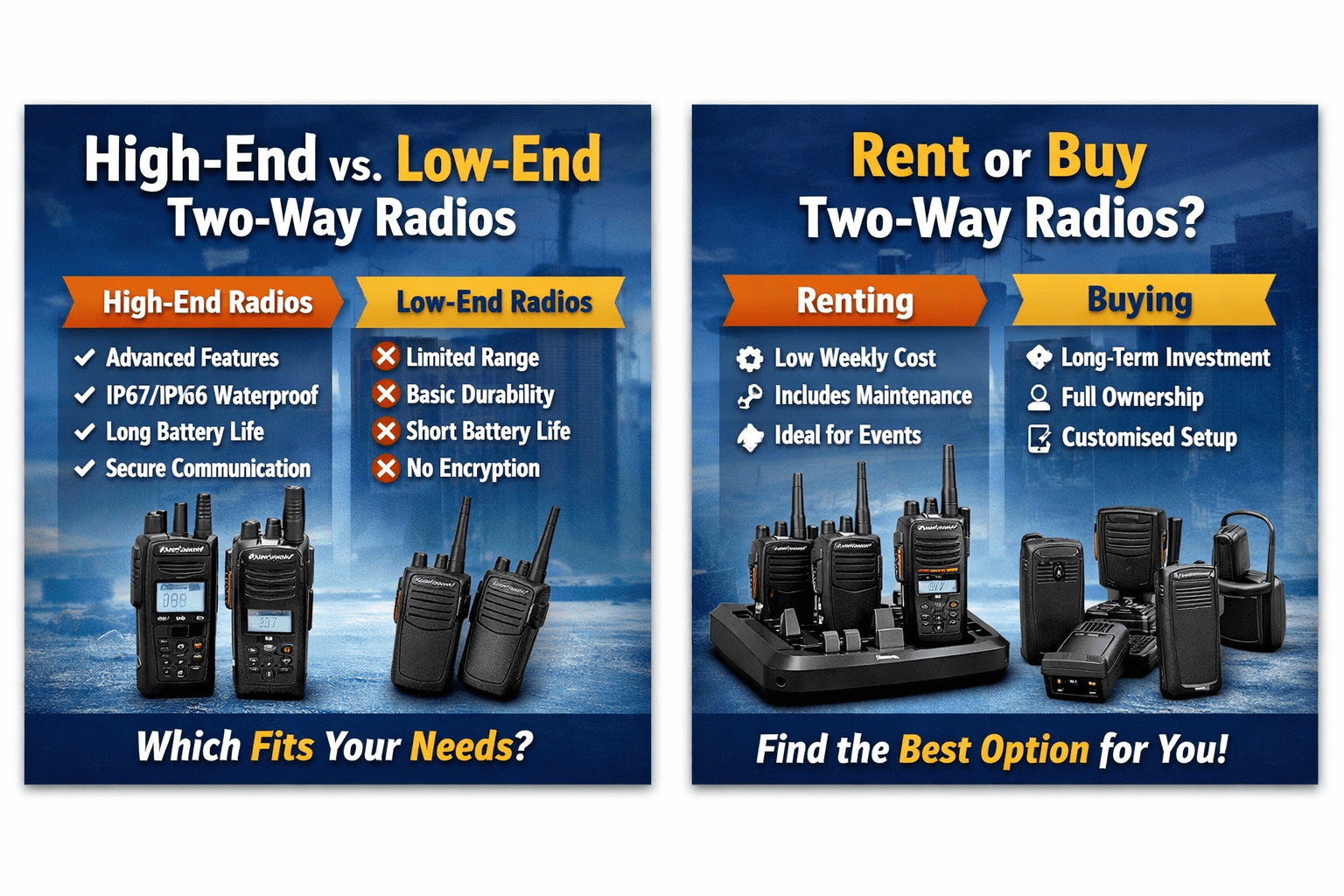
High-End vs Low-End Two-Way Radios: 2026 Complete Buyer’s Guide
Learn the difference between high-end and low-end two-way radios in 2026. Compare durability, battery life, digital features, licensing requirements, and long-term ROI to choose the right solution for your business or event.
Poor communication doesn’t just slow operations — it increases risk, reduces efficiency, and costs money. Whether you’re managing a retail security team, coordinating a construction project, operating a stadium, or running a hospitality venue, your radio system must perform flawlessly.
In 2026, the gap between high-end professional radios and low-end consumer walkie-talkies has widened significantly. This guide explains exactly what separates them — and when investing in premium equipment truly makes sense.
By the end, you’ll know which solution fits your operational needs, budget, and compliance requirements.
Understanding High-End and Low-End Two-Way Radios
Two-way radios fall into two broad categories:
Low-End (Consumer-Grade) Radios
Typically found in electronics shops or online marketplaces, these radios:
Operate on licence-free PMR446 frequencies
Offer limited power (0.5W–2W)
Use analog technology
Have minimal durability ratings
Are designed for casual or recreational use
They are ideal for:
Short-term personal use
Small indoor spaces
Low-risk environments
High-End (Professional-Grade) Radios
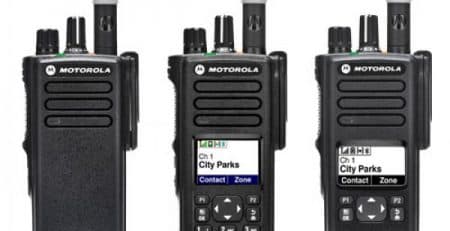
Manufactured by industry leaders such as Motorola Solutions, Hytera, Icom, and Tait Communications, these radios are built for mission-critical environments.
They typically include:
Licensed UHF/VHF frequencies
4W–5W transmit power (or higher)
Digital standards such as DMR or TETRA
IP67/IP68 waterproof ratings
Military-grade durability testing
Advanced safety features
They are designed for:
Security teams
Construction sites
Stadiums and festivals
Hospitality operations
Transport and logistics
Public safety environments
Understanding this distinction is the first step toward making the right investment.
Key Features to Compare
Range and Signal Reliability
Range is not just about distance — it’s about signal penetration and stability.
Low-End Radios
Advertised range: 1–5 miles (line of sight only)
Real-world urban range: Often under 1 mile
Struggle in cities, indoors, or dense structures
No repeater compatibility
In built-up environments with concrete, steel, or heavy crowds, signal degradation is common.
High-End Radios
5W+ transmit power
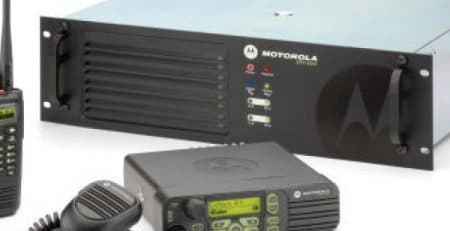
Repeater compatibility for extended coverage
Urban coverage up to 10km with infrastructure
Digital clarity at the edge of range
Digital DMR systems maintain clearer audio over longer distances compared to analog models, which degrade into static.
For stadiums, shopping centres, and construction sites, this difference is critical.
Durability and Build Quality
Professional environments are tough on equipment.
High-End Radios
IP67/IP68 ratings (dustproof, waterproof, submersible)
MIL-STD-810 military drop testing
Impact-resistant polycarbonate alloys
Weatherproof for UK climate conditions
These radios can survive drops, heavy rain, dust exposure, and daily operational abuse.
Low-End Radios
Often IP54 or lower
Plastic casing
Limited drop resistance
Vulnerable to moisture and dust
For retail security, outdoor events, or construction operations, durability alone often justifies the upgrade.
Battery Life and Power Management
Communication must last an entire shift.
Low-End Models
NiMH or alkaline batteries
8–12 hours of moderate use
Long recharge cycles (6–8 hours)
Voltage drop over time
High-End Models
High-density lithium-ion batteries
18–30+ hour shift life
1–3 hour rapid charging
Smart battery diagnostics
Multi-unit charging stations
For 24-hour operations, hospitality teams, or security patrols, extended battery life reduces downtime and operational disruption.
Digital vs Analog Technology
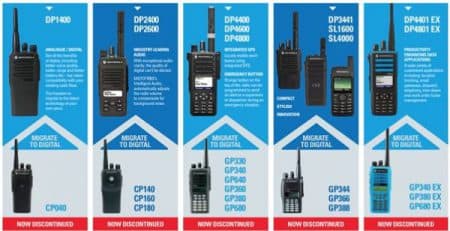
The move toward digital radio systems continues to accelerate in 2026.
Analog (Common in Low-End Radios)
Susceptible to interference
Audio fades gradually into static
No encryption
Limited channel capacity
Digital (High-End Radios)
Crystal-clear audio
Better spectrum efficiency
Encryption for secure communication
Text messaging capability
GPS tracking
Man-down alerts
Noise cancellation technology
Digital systems reduce miscommunication in loud environments such as concerts, transport hubs, or busy hotels.
Licensing and UK Regulations
In the UK, radio licensing is regulated by Ofcom.
Licence-Free Radios (PMR446)
Limited to 0.5W
Shared public channels
Suitable for low-risk, small operations
Higher risk of interference
Licensed Professional Radios
Simple UK Light Licence available
Higher transmit power allowed
Dedicated frequencies
Repeater access
Reduced interference risk
Failure to comply can result in fines of up to £5,000.
For businesses operating in London or high-density environments, licensed radios are strongly recommended.
Advanced Features That Justify High-End Pricing
Professional radios now integrate smart capabilities:
GPS fleet tracking
Bluetooth accessory pairing
Wi-Fi programming
Lone worker protection
Man-down sensors
AES encryption
Capacity Plus multi-site systems
Hybrid LTE/Push-to-Talk over Cellular
These features are particularly valuable in:
Stadium security
Construction site safety
Retail shop watch schemes
Film production crews
Transport fleet coordination
Consumer radios do not offer these capabilities.
2026 Market Trends
The global two-way radio market is projected to reach approximately $11.6 billion in 2026, growing at nearly 8.6% CAGR.
Key trends include:
Digital migration (DMR & TETRA adoption)
Explosion-proof radio demand in construction and industrial sectors
Hybrid LTE-radio systems
AI-based noise suppression
Integration with body-worn cameras
Increased cybersecurity requirements
Businesses investing in professional systems are future-proofing their communication infrastructure.
Top High-End Models in 2026
Some leading professional models include:
Motorola MOTOTRBO R7 – Advanced noise suppression and IP68 durability
Motorola XPR 7550e – GPS, Wi-Fi, Bluetooth, multi-site scalability
Hytera HP68X – AI noise cancellation and construction-ready design
Tait TP9600 – High-output security and transport applications
These radios range between £500–£1,500 per unit depending on configuration.
Hire vs Buy: Which Is Better in London?
Hiring High-End Radios
Typical hire cost:
£11–£20 per unit per week
Includes:
Licensing
Chargers
Batteries
Programming
Maintenance
Technical support
Ideal for:
Events
Seasonal retail
Film shoots
Short-term construction projects
Hiring avoids:
Large capital expenditure
Depreciation
Technology obsolescence
Repair responsibility
Buying High-End Radios
Purchase cost:
£500–£1,500 per unit
Additional costs:
Licensing fees
Maintenance
Battery replacements
System upgrades
Repeater infrastructure
Buying is more suitable for:
Long-term fixed operations
Large security firms
Permanent transport networks
Industry Applications in London
Retail & Shop Watch
High-end radios reduce theft response time and support coordinated communication between stores.
Hospitality & Hotels
Digital radios improve coordination between concierge, security, housekeeping, and management.
Stadiums & Events
Noise cancellation and multi-channel coordination are essential in high-capacity venues.
Construction & Transport
Rugged IP68 radios with GPS tracking enhance safety and compliance.
Film Studios & Media
Silent text messaging and discreet earpieces reduce disruption during production.
Frequently Asked Questions
Are high-end radios worth the investment?
Yes, if communication reliability impacts safety, revenue, or reputation.
Can low-end radios work for small teams?
Yes, in low-risk environments with minimal interference.
Do professional radios require licensing?
Most do in the UK. Always check with Ofcom or your supplier.
Is digital better than analog?
For business use, digital provides clearer audio, better range, and enhanced security.
Conclusion: Making the Smart Choice in 2026
High-end radios deliver superior durability, battery life, security, and long-term ROI. For professional operations in retail, hospitality, construction, or events, they significantly outperform consumer walkie-talkies.
Low-end radios may be sufficient for casual or temporary personal use, but they fall short in mission-critical environments.
Before deciding:
-
Assess your coverage needs
-
Evaluate licensing requirements
-
Consider durability demands
-
Calculate long-term cost vs short-term hire
Reliable communication is not a luxury — it’s operational infrastructure.
If your business depends on coordination, safety, and speed, investing in the right two-way radio solution is one of the smartest decisions you can make in 2026.