+44 7966 145 771
The Strategic Role of Radio Communication for Facilities Management
Did you know that 73% of facilities management teams in the UK resort to reactive problem-solving on a weekly basis because they lack real-time insights? In a high-pressure estate environment, relying on consumer-grade mobile devices often leads to critical failures in basements or reinforced concrete stairwells. You likely understand the frustration of a security alert or a maintenance request being delayed simply because a team member was out of signal range. Effective radio communication for facilities management is no longer just a luxury; it’s a fundamental requirement for operational continuity and safety.
This guide explores how professional two-way radio systems eliminate communication dead zones and provide the instant connectivity needed to manage disparate teams. We’ll examine the technical standards for 2026, including DMR V2.7.1, and explain how to ensure your site remains compliant with British Standard BS 8484:2022 for lone worker protection. By the end of this article, you’ll understand how to transform your estate’s communication from a logistical hurdle into a seamless, dependable backbone for your entire operation.
Key Takeaways
- Understand why a private, secure network is superior to mobile devices for estate operations, providing instant Push-to-Talk connectivity without the latency of public cellular infrastructure.
- Learn how site surveys and Digital Mobile Radio (DMR) standards ensure clear audio and total coverage across complex environments, including reinforced concrete stairwells and basement levels.
- Discover how to integrate safety features like ‘Man Down’ and ‘Lone Worker’ check-ins to protect night-shift engineers and meet your legal duty of care obligations.
- Identify the most effective ways to coordinate disparate security, cleaning, and maintenance teams through integrated radio communication for facilities management.
- Evaluate the financial and logistical benefits of managed radio hire versus purchase to determine the best model for your site’s maintenance and licensing requirements.
Professional radio communication for facilities management establishes a private, secure network that operates entirely independently of public cellular infrastructure. Unlike consumer devices that rely on shared network capacity, these systems provide a dedicated channel for estate operations. This independence ensures that in the event of a public network outage or high local congestion, your facility’s internal logistics remain unaffected. Facilities Management Radio Systems are the primary tool for operational continuity and health and safety compliance, serving as a reliable safeguard for both staff and property.
The core advantage lies in the immediacy of Push-to-Talk (PTT) technology. Mobile phones introduce significant latency, requiring users to unlock screens, navigate apps, and wait for a connection. In a professional setting, those seconds represent ’empty time’ that delays response. Professional Mobile Radio (PMR) systems provide instantaneous connection, allowing managers to coordinate maintenance, cleaning, and security teams with a single button press. This streamlined approach reduces operational friction and ensures that instructions are received and acted upon immediately.
Why Mobile Phones Fail in Modern Estates
Architectural choices in modern developments often create hostile environments for cellular signals. Thick reinforced concrete and steel frames result in the ‘basement effect’, where mobile phones lose connectivity entirely in lower levels, plant rooms, or stairwells. Professional radio systems utilise specific frequencies designed for their ability to penetrate these dense materials. Additionally, mobile devices lack the robust group-call capabilities essential during site-wide emergencies, where a single broadcast must reach every department simultaneously without the risk of a dropped call or signal buffering.
Departmental Integration: From Security to Front-of-House
Efficiency depends on the seamless integration of diverse teams. In retail environments or healthcare centres, radio communication for facilities management facilitates rapid room turnarounds and immediate spill clean-ups, preventing minor incidents from escalating into safety hazards. For front-of-house and hospitality staff, discreet accessories allow for quiet communication amongst the team. This maintains professional decorum whilst ensuring that logistical needs are met behind the scenes without disturbing the guest experience. It transforms a group of separate departments into a single, responsive unit.
Technical Standards: DMR, Trunking, and Site Coverage
Digital Mobile Radio (DMR) is the established industry standard for 2026, offering superior audio clarity through advanced noise-cancelling technology. In environments like plant rooms or busy loading bays, DMR handsets filter out background machinery hum, ensuring that every transmission is intelligible. This digital protocol also allows for more efficient use of licensed frequencies, providing two separate communication paths on a single channel. This efficiency is vital when implementing radio communication for facilities management across large-scale commercial estates where channel congestion is a common hurdle.
Scaling a system to accommodate hundreds of users requires a move toward trunking. By utilising high-capacity system architectures, a network can dynamically allocate available channels to different groups, such as security, cleaning, and engineering. This prevents users from being “blocked” during peak times. Effective communication is the cornerstone of safety protocols, often aligning with international best practices such as OSHA requirements for emergency plans, which mandate clear procedures for reporting site-wide incidents. For estates requiring a bespoke technical assessment, our team can provide a professional site survey to ensure total coverage.
Durability remains a primary differentiator between professional handsets and consumer-grade electronics. Professional radios carry high Ingress Protection (IP) ratings, often IP67 or IP68, meaning they’re completely dust-tight and capable of withstanding immersion in water. This resilience is essential for maintenance teams working in exposed areas or engineers handling repairs in damp service tunnels where a standard mobile device would likely fail.
UHF vs VHF: Choosing the Right Frequency for Your Building
Ultra High Frequency (UHF) is the preferred choice for indoor radio communication for facilities management. Its shorter wavelengths are more effective at penetrating the steel, brick, and reinforced concrete found in modern office blocks and shopping centres. Conversely, Very High Frequency (VHF) is typically reserved for large outdoor estates or grounds management. Whilst VHF signals travel further over open land, they’re easily obstructed by the dense structural elements of urban buildings.
The Necessity of Professional Site Surveys
In dense urban environments like the City of London, Wembley, or Slough, frequency planning is a technical necessity. Without it, your system may suffer from interference from neighbouring businesses. A professional site survey identifies these potential conflicts and maps out dead spots caused by structural shielding. We then utilise strategically placed repeaters to boost signals, ensuring that coverage extends to every corner of a multi-storey facility, from the highest rooftop plant room to the deepest basement storage level.
Enhancing Safety with Lone Worker and Emergency Features
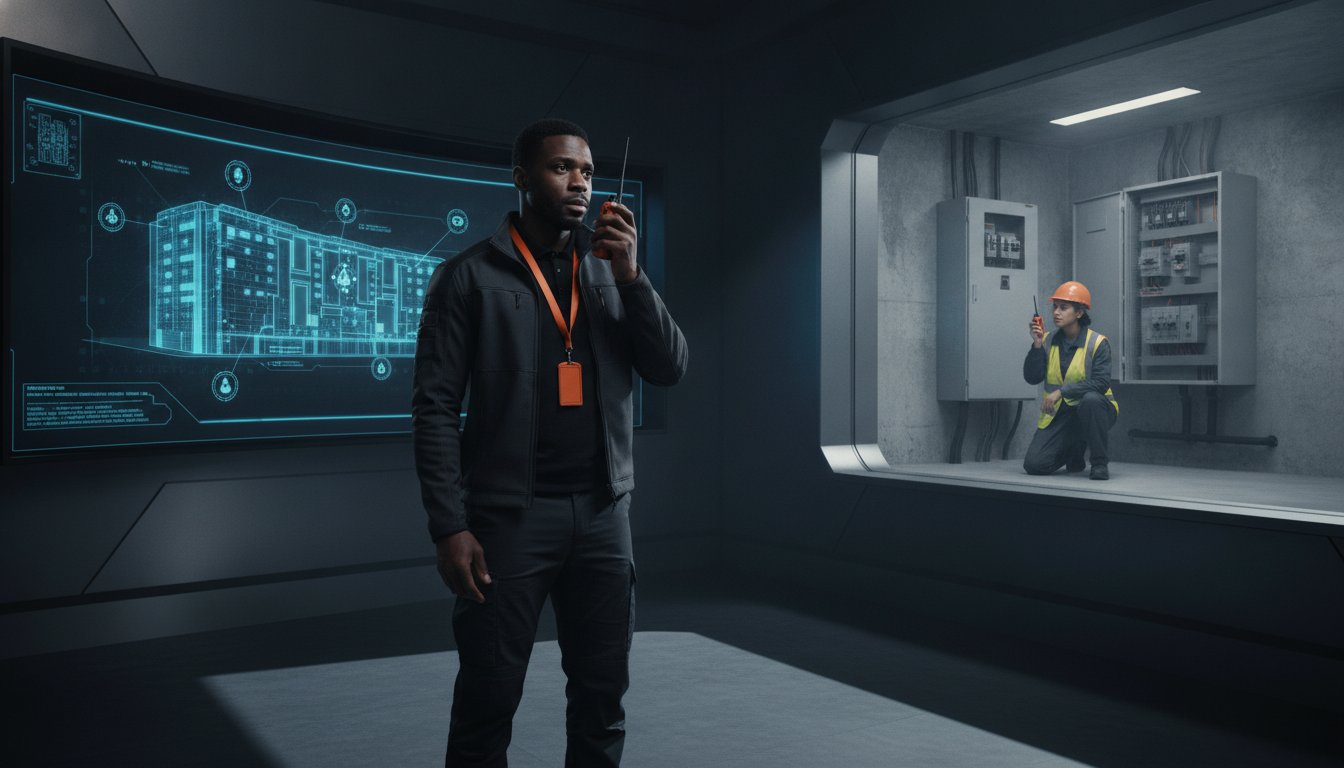
Effective radio communication for facilities management is central to meeting your legal duty of care under the Health and Safety at Work Act 1974. With an estimated 8 million lone workers in the UK, the ‘Lone Worker’ feature provides a vital safety net. This function requires staff, such as night-shift engineers or plant room technicians, to check in at scheduled intervals. If a response is missed, the system automatically triggers a priority alarm. This is complemented by ‘Man Down’ technology, which uses internal accelerometers to detect sudden falls or sustained lack of movement, instantly alerting the control centre to a potential medical emergency or accident.
During a critical incident, communication clarity is paramount. Dedicated emergency buttons on professional handsets allow users to override all other radio traffic, ensuring their distress signal reaches the entire team without delay. Modern digital radios also integrate directly with Building Management Systems (BMS) to receive automated fire alerts. This integration ensures that when a sensor is triggered, a text or voice notification is sent immediately to the relevant handsets, allowing for a faster, more coordinated response. If you need to upgrade your site’s safety protocols, you can contact our team for a tailored safety solution.
Body Cameras: The New Frontier of FM Security
Body-worn cameras are increasingly utilised alongside radio systems in public-facing environments like hospitals and shopping centres. These devices provide an objective, high-definition record of interactions, which is essential for protecting staff from false accusations and resolving disputes. The presence of visible security technology often acts as a significant deterrent, reducing the likelihood of aggressive behaviour toward facilities staff whilst they perform their duties.
GPS Tracking and Indoor Positioning
Logistical precision is enhanced through GPS and indoor positioning data. Managers use this real-time location data to optimise patrol routes and ensure that security or cleaning teams are covering all necessary areas of a large estate. In the event of a security breach or a medical alert, knowing a staff member’s exact coordinates allows for the most efficient deployment of support, especially in complex multi-storey buildings where finding a specific individual quickly can be challenging.
Managed Radio Hire vs Purchase: Selecting the Right Model
Choosing the correct acquisition model for radio communication for facilities management involves balancing immediate capital expenditure (CAPEX) against ongoing operational expenditure (OPEX). Purchasing equipment outright provides long-term ownership but places the responsibility for maintenance and technical updates on your internal teams. For many estates, a managed hire agreement is the more dependable route. This model offers a predictable cost structure whilst ensuring that your hardware remains current and fully functional through a comprehensive service package.
A managed service from a specialist partner like Ears PLC removes the logistical burden of hardware upkeep. We provide regular battery replacements, firmware programming, and rapid repairs, ensuring that your communication backbone never falters. We also take responsibility for the administrative complexities of Ofcom applications. This ensures your facility operates within legal parameters on dedicated business frequencies. As your estate grows, a bespoke system design allows for scalable expansion, adding handsets or increasing coverage without disrupting existing workflows.
Understanding UK Radio Licensing (Ofcom)
Navigating UK radio licensing is essential to avoid signal jamming and legal repercussions. Whilst “UK Light” licences allow for general use across the country, they often suffer from interference in crowded urban centres. For robust radio communication for facilities management, we typically recommend site-specific technically assigned licences. These provide a protected frequency for your exclusive use within a defined area. Professional frequency planning is the only way to ensure your security and maintenance teams don’t experience “crosstalk” from neighbouring sites.
Maintenance and Technical Support
System reliability is not accidental; it is the result of rigorous preventative maintenance. Routine checks identify potential hardware fatigue or signal degradation before they cause a failure during peak operational hours. Our approach includes dedicated project management and on-site support to ensure a seamless transition when deploying new networks. This steady, experienced oversight guarantees that your team can focus on estate stewardship whilst we handle the technical precision of the network. Contact Ears PLC today to book a professional site survey for your facility.
Securing Your Estate’s Operational Future
Modern estate management requires more than just basic connectivity; it demands a resilient infrastructure capable of supporting high-pressure environments. Transitioning to Digital Mobile Radio (DMR) standards and integrating automated safety features like ‘Man Down’ alerts provides a robust framework for risk mitigation. By prioritising a private network over public cellular signals, you ensure that your team remains coordinated even in the most challenging structural environments, from reinforced basements to high-rise rooftops.
Implementing effective radio communication for facilities management is a strategic investment in both safety and efficiency. As official partners for Motorola, Hytera, and ICOM, Ears PLC brings over 25 years of experience in London radio systems to every project. We provide expert Ofcom licensing and frequency planning support to ensure your network is fully compliant and free from local interference. This steady, experienced oversight allows your team to focus on proactive stewardship rather than reactive troubleshooting.
Whether you require a managed hire solution or a permanent system installation, we are ready to assist in optimising your site’s logistics. Design your bespoke facilities management radio system with Ears PLC today to ensure your estate operations are supported by a dependable and professional communication backbone.
Frequently Asked Questions
Why is a two-way radio better than a mobile phone for facilities management?
Professional radios provide instantaneous Push-to-Talk connectivity and group broadcast capabilities that mobile devices cannot match. This allows a facilities manager to alert an entire team simultaneously during a security breach or emergency. Unlike cellular networks, these systems operate on private frequencies, ensuring reliability in basements and plant rooms where mobile signals typically fail.
Do I need a licence to use two-way radios in my UK business?
Yes, most professional radio systems used for business in the UK require an Ofcom licence to operate legally. Whilst some low-power “licence-free” radios exist, they’re often unsuitable for complex estates due to interference and limited range. Most organisations opt for a site-specific licence, which provides a protected frequency to ensure clear radio communication for facilities management without external disruption.
What is the difference between UHF and VHF for building management?
UHF (Ultra High Frequency) is the standard choice for indoor environments because its shorter wavelengths penetrate steel and concrete more effectively. VHF (Very High Frequency) signals travel further over open ground but are easily blocked by modern building materials. For multi-storey office blocks or shopping centres, UHF provides the consistent coverage required for operational stability.
Can two-way radios integrate with my existing fire alarm system?
Digital radio systems can be integrated with your Building Management System (BMS) to provide automated fire alarm notifications. When a fire panel is triggered, the system sends a direct text or voice alert to designated handsets. This allows security and maintenance teams to identify the exact location of the alarm immediately, facilitating a faster and more organised evacuation process.
What are the ‘Lone Worker’ and ‘Man Down’ features on a digital radio?
These are critical safety functions designed to protect staff working in isolation. The Lone Worker feature requires the user to press a button at pre-set intervals to confirm they’re safe. Man Down technology uses an internal accelerometer to detect a change in the radio’s orientation or a lack of movement, automatically triggering an emergency alarm if a fall or accident is suspected.
How long do professional two-way radio batteries last on a single charge?
Professional digital radios are designed to last between 12 and 18 hours on a single charge, comfortably covering a standard long shift. Modern Lithium-Ion battery technology ensures that handsets remain lightweight whilst maintaining a high power capacity. For 24-hour operations, we recommend a managed service that includes regular battery health checks and replacements to prevent unexpected downtime.